© Ryan Velting. All rights reserved.
Most product photography projects do not fail during the shoot.
They fail in the two weeks before it.
The problems that show up after delivery - wrong crop ratios, missing angles, files that do not work for the intended platforms, shot lists that covered the product but not the use case - almost always trace back to decisions that were not made, or questions that were not asked, before anyone touched a camera.
Planning is where a product photography project either works or does not. The shoot is where you find out which one it is.
What "Planning" Actually Means
For a straightforward single-product shoot with a simple deliverable, planning can be relatively light. Confirm the product, confirm the backgrounds, confirm the file format, show up and shoot.
But most product photography projects that matter to an organization are not that simple. They involve multiple SKUs, multiple intended uses, multiple stakeholders with different needs, and files that have to function across product pages, catalogs, retailer platforms, social channels, advertising, and internal systems. Often they are not a single event - they are the first phase of an ongoing working relationship where the decisions made in phase one affect every phase that follows.
At that scale, planning is not a preliminary step. It is a discipline.
The Questions That Have to Get Answered Before Shoot Day
A product photography project does not start with the products arriving at the studio. It starts with a set of questions that determine whether the files that come out of the shoot will actually be usable.
Where will these images be used? A product page, a distributor listing, a printed catalog, a paid ad, a trade show display, and an email header all have different technical requirements. The crop ratios are different. The file sizes are different. The safe zones for overlaid text are different. Images that work in one context may not work in another. If this conversation does not happen before the shoot, the team will either get files that do not fit the intended uses, or they will be back with the photographer after delivery asking for versions that were never planned for.
What does each image need to accomplish? There is a meaningful difference between a documentation image — one that shows the product clearly and accurately for a catalog or product page — and a marketing image, which needs to give a brand more visual presence for a campaign or paid placement. Some projects need both. Many teams assume the photographer will figure out which one they need. The photographer often assumes the client already knows. That gap creates problems.
How will the files be named, organized, and delivered? For a team managing a catalog of hundreds or thousands of SKUs across multiple platforms, file delivery is not an afterthought. It is one of the most operationally significant parts of the project. Files named by the photographer's convention rather than the client's internal product IDs create sorting work downstream. Deliverables that are not organized around how the team actually needs to use them create friction at exactly the moment the team is trying to move fast.
Who needs to approve what, and when? On a larger catalog project, there are often multiple stakeholders involved — product managers, marketing coordinators, brand managers, sometimes a retail partner with their own image requirements. Understanding who has approval authority and at what stage matters. A project that goes through shoot, delivery, and review, and then discovers that a key stakeholder had requirements the photographer never heard about, is an expensive project to fix.
Why These Questions Get Skipped
The most common reason planning gets compressed is urgency. A product launch is coming. A catalog refresh is overdue. A retailer has a deadline. The instinct is to get to the shoot as fast as possible because that is what feels like progress.
But a shoot that produces files the team cannot use is not progress. It is a delay with a larger price tag.
The second reason is assumption. Clients often assume photographers will ask the right questions. Photographers often assume clients have already thought through their needs. Both are reasonable assumptions and both are frequently wrong. Good planning is not about distrust — it is about making sure the things that need to be explicit actually are.
The third reason is that planning is invisible. Nobody sees the brief, the shot list, the file naming convention, or the pre-shoot communication. They see the final images. When a project goes well, the planning looks like it was unnecessary. When a project goes poorly, the planning looks like what was missing.
What Good Planning Looks Like in Practice
A well-planned product photography project starts with a discovery conversation that goes beyond "how many products and what backgrounds." It covers the full scope of intended uses, the platforms and formats the files need to serve, the approval structure, the delivery timeline, and any technical constraints on the client side.
From that conversation, a brief gets built. The brief is not a formality. It is the document that protects both sides. It defines what the project is, what success looks like, and what falls outside the scope of the current engagement. On a multi-stage project, it also establishes what the first phase needs to deliver for the second phase to work.
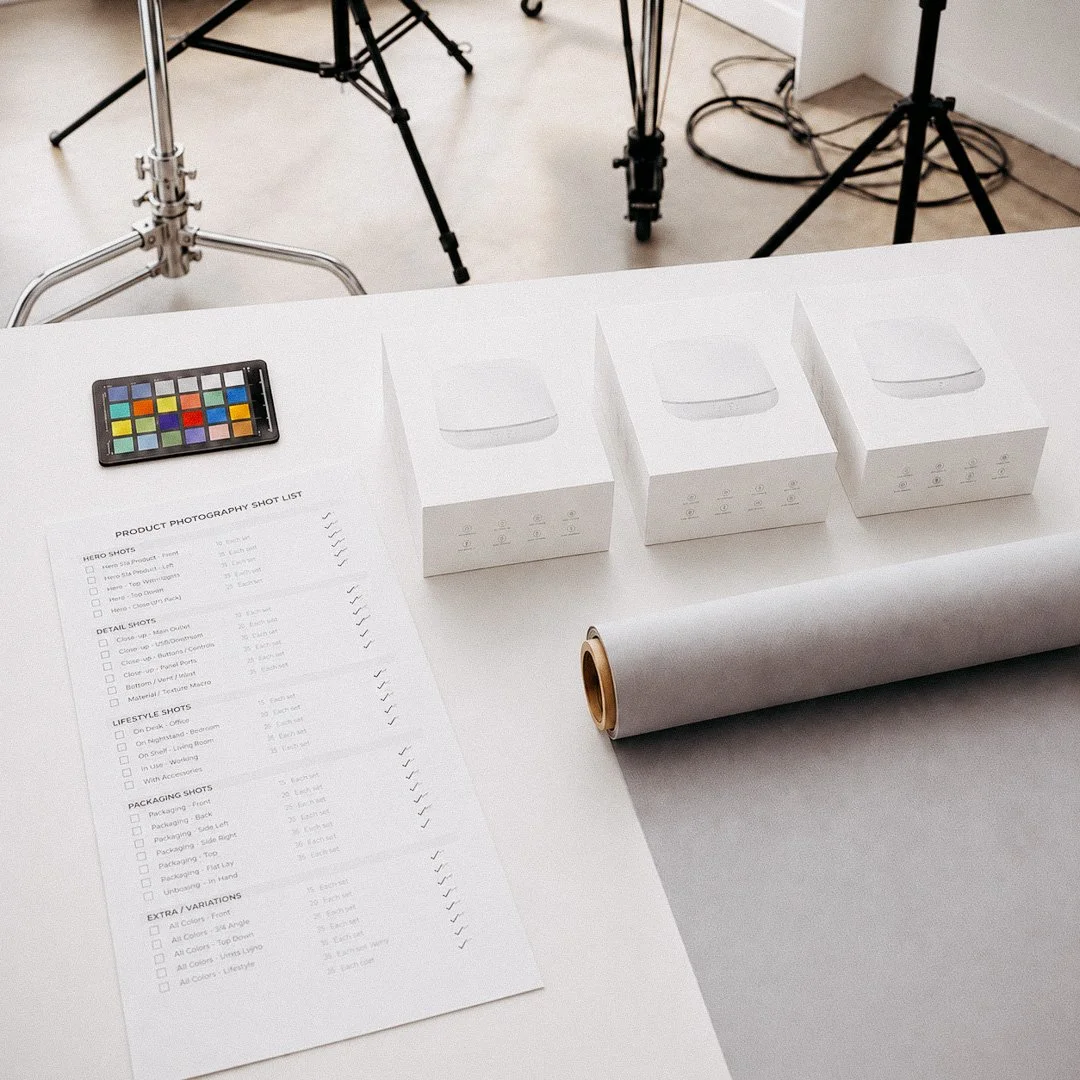
A shot list follows from the brief. A real shot list is not just a count of products — it is a breakdown of angles, orientations, and variants for every SKU, cross-referenced against the intended uses established in the discovery conversation. It is the document that makes the shoot day efficient and makes sure nothing gets missed.
File delivery specs are confirmed before the shoot, not after. Platform specs, naming conventions, folder structure, and format requirements are established as part of planning so the deliverables match what the team actually needs when they arrive.
On a long-term project, that planning layer compounds in value. The systems built for phase one become the foundation for phase two. A photographer who understands the client's catalog, platforms, approval process, and brand standards can move faster and produce more consistent results across every subsequent stage of the work.
A Resource Worth Having Before Your Next Project
If you are planning a product photography project and want a clear picture of what to think through before the shoot, I put together a free planning guide specifically for e-commerce teams, catalog managers, and product managers working across multiple SKUs and platforms. It covers the key decisions, questions, and technical considerations worth resolving before any photographer shows up.
No sign-up, no email required. Link is in the first comment.
The guide does not replace a good pre-production conversation - but it is a useful starting point for knowing what that conversation should cover.